
The city of Dhaka, a vibrant hub of history and modernity, has become a key stage for the remarkable evolution of poker in Bangladesh. What began as a casual pastime in local gatherings and clubs, often viewed under the shadow of “gambling,” has transformed into a sport of skill and strategy, officially recognized as a Mind Sport by the International Mind Sports Association (IMSA) in 2024.
For residents of Dhaka, poker is more than just a set of rules; it’s an exercise in reasoning, logic, and crucially, risk management. In a metropolis defined by competition and quick decision-making, Texas Hold’em No-Limit (NLH) provides an ideal arena for developing analytical skills. The game requires players to calculate probabilities (Pot Odds), evaluate the expected value of each move (Expected Value – EV), and maintain strict emotional control to avoid tilting under pressure.
Dhaka: Where Poker Thrives and Evolves in Bangladesh
Poker’s presence in Dhaka has deep cultural roots, tracing back to times when migrants and workers in the growing metropolis gathered in makeshift tea stalls and discreet venues for card games. Poker established itself as a social convergence point, where camaraderie and strategy met after long workdays, especially in historic areas and neighborhoods with strong community ties.
Despite this cultural footprint, gambling – including poker – remains illegal under Bangladeshi law, so both live and online games typically operate in a legal grey area or in outright prohibited formats. As a result, much of the local scene remains discreet and informal, even as interest in the game continues to grow.
As the city expanded, the game evolved from informal meetups to more structured private clubs. While not comparable to the grand casinos of yesteryear, from the 2010s onward, poker began to appear in local entertainment circles, reflecting reduced stigma and growing social acceptance among certain groups. These venues have become more organized and welcoming spaces, far from smoky backrooms, attracting regular crowds of enthusiasts and signaling poker’s solidification as both entertainment and sport for a niche but dedicated community.
The competitive core of modern poker lies in its mathematics. Unlike dice games, NLH is a game of incomplete information that demands precise estimation of risk and reward for every bet. The central concept is Expected Value (EV), the average profit or loss a play would yield if repeated countless times. Professionals always pursue decisions with positive EV.
To achieve this, analyzing Pot Odds is essential. They represent the ratio between the total pot size and the cost to call a bet. This ratio is compared to the player’s Equity (the percentage chance of winning) in their hand. If the odds of winning exceed the relative cost to stay in, the decision is profitable long-term, even if that specific hand loses. The discipline to apply this calculation consistently, ignoring short-term luck (Variance), defines professional longevity.
To speed up these calculations, players use shortcuts like the Rule of Two and Four, a quick estimate that converts the number of outs (cards that improve the hand) into a win percentage. Mastering these tools shows that poker is a microcosm of Game Theory, where skill triumphs over luck through high-volume data analysis. For example, the chart below illustrates how different starting hands in No-Limit Texas Hold’em have distinct mathematical values, forming the basis for many preflop decisions.
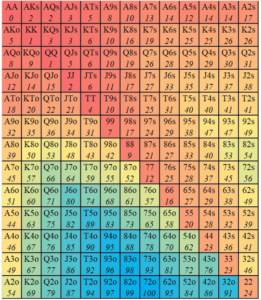
Starting hand strength chart in No-Limit Texas Hold’em
Technology, Growth, and the Human Element in Poker
The growing popularity of poker in Bangladesh has been fueled by the rise of online platforms. The digital realm has not only democratized access, allowing competitors from across the country to join, but also introduced technological innovations that enhance security and game integrity.
Recently, blockchain technology has emerged as a new frontier. This allows for decentralized designs where hand outcomes aren’t controlled by a single entity, reducing fraud risks and providing greater transparency.
Blockchain architecture uses advanced cryptography and distributed networks to secure accounts and transactions, and it can enable pseudonyms and cryptocurrencies for added privacy, appealing to tech-savvy enthusiasts focused on digital security. For players interested in trying online poker, independent resources such as GipsyTeam maintain up-to-date reviews of offshore rooms – including major brands like Bovada Poker, one of the most prominent US-facing poker sites – even though local law still treats most forms of online gambling as illegal or unregulated for Bangladeshi residents. This digital evolution ensures the sport continues to flourish for those who participate, delivering a high-quality experience and fair competition environment.
Online poker keeps growing every day, but despite all the mathematics and technology, players’ performance is continually tested by the human element. Emotional control is deemed the most vital skill, especially in No-Limit games where all-in pressure is constant. The main challenge is avoiding tilt, the frustrated state that leads players to stray from rational EV-positive strategies, often after an unexpected loss (bad beat).
Tilt is essentially a failure in behavioral risk management. Professional players must cultivate a mindset that separates decision quality (EV) from immediate outcomes (luck). The ability to stay calm and focused, even after major setbacks, ensures a return to analytical planning and long-term profitability. Just like in any high-performance sport, whether physical or mental, discipline, resilience, and mind mastery are the keys to longevity and success.